Anxiety Clinic: Cognitive Psychotherapy for Anxiety Disorders, Panic Attacks, and Phobias
An anxiety clinic – in German known as Angstambulanz, in Switzerland as Angstambulatorium – is a psychotherapeutic institution specialized in anxiety disorders, panic disorders, and phobias. The Anxiety Clinic at Lake Zurich of Dr. Dietmar Luchmann, LLC, pursues a single goal: it frees people from their anxiety — without medication, without years of conversation, in absolute confidentiality.
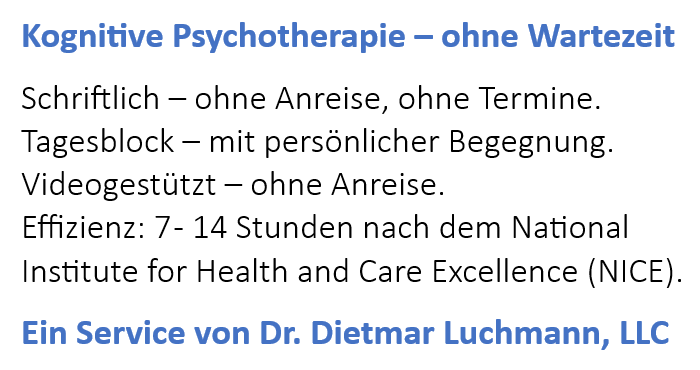
International guidelines for the treatment of anxiety and panic disorders, formulated by the United Kingdom's National Institute for Health and Care Excellence (NICE), specify a treatment range of 7 to 14 hours — no more is needed to resolve an anxiety disorder. Within precisely this timeframe, the Anxiety Clinic leads its patients back to a life free of anxiety and panic attacks.
This path comes in three forms: in writing online, by video, or in a single day of personal conversation. Which form suits the individual case emerges from the preparation — the choice remains with the patient. Whoever wishes can complete the entire cognitive psychotherapy without ever traveling.
Which Anxiety Disorders Are Treated?
The Anxiety Clinic treats all recognized anxiety disorders. The overview below places each diagnosis in context and gives the official classification codes.
This overview is intended for initial orientation and does not replace a psychodiagnostic assessment. The code before each diagnosis corresponds to the newer ICD-11 classification; the code in parentheses after it to the older ICD-10.
Anxiety or Fear-Related Disorders
- 6B00 Generalized Anxiety Disorder (F41.1)
- A persistent, often groundless worry that lasts for months and is tied to no particular situation. It is accompanied by inner restlessness, tension, difficulty concentrating and sleeping, and the sense of never being able to switch off. The worries typically revolve around everyday life, family, or health.
- 6B01 Panic Disorder (F41.0)
- Sudden, unexpected attacks of intense fear accompanied by physical sensations such as a racing heart, shortness of breath, dizziness, or trembling. Between attacks, the worry about the next one often remains. Harmless bodily signals are frequently misread as threatening.
- 6B02 Agoraphobia (F40.0)
- A pronounced fear of situations from which escape would be difficult, or in which help would be unavailable in an emergency—such as crowds, public transport, standing in line, or leaving the house alone. Such situations are avoided, which progressively narrows one’s range of movement.
- 6B03 Specific Phobia (F40.2)
- A strong, persistent fear of a particular object or situation that triggers anxiety almost instantly and is avoided, even though the actual danger is slight. Examples include animals, heights, enclosed spaces, or the sight of blood and needles. Such fears often begin in childhood.
- 6B04 Social Anxiety Disorder (F40.1)
- A pronounced fear of situations in which one might be observed or judged by others—speaking before groups, social encounters, or performance—driven by the worry of embarrassing oneself or being rejected. Visible signs such as blushing or trembling are especially feared.
- 6B05 Separation Anxiety Disorder (F93.0)
- An excessive fear of separation from people one is close to, coupled with worry about their well-being or one’s own. Contrary to common assumption, it occurs not only in children but also in adults—for instance, in relation to a partner or one’s children.
- 6B06 Selective Mutism (F94.0)
- A consistent failure to speak in certain social situations—such as at school—while speech is normal in familiar surroundings. The capacity for speech itself is unimpaired. It usually appears in childhood and is often associated with social anxiety.
Anxiety disorders are frequently accompanied by further conditions, which we treat insofar as they are connected with the anxiety:
Obsessive-Compulsive or Related Disorders
- 6B20 Obsessive-Compulsive Disorder (F42.-)
- Recurrent, unwanted thoughts that force themselves upon the mind, and/or repeated actions and rituals meant to ease the tension these thoughts provoke. Common themes are cleanliness, order, or control. The compulsions can consume a great deal of time and considerably disrupt daily life.
- 6B21 Body Dysmorphic Disorder (F45.2)
- A persistent, distressing preoccupation with one or more perceived flaws in one’s appearance that are barely noticeable, or not noticeable at all, to others. Typical behaviors include repeated checking in the mirror, concealment, or comparing oneself with others. Note: Body dysmorphic disorder (6B21) and health anxiety (6B23) both map to F45.2, because the older ICD-10 grouped them together under hypochondriacal disorder; only ICD-11 separates them as distinct diagnoses.
- 6B23 Hypochondriasis / Health Anxiety (F45.2)
- A persistent fear or conviction of having or developing a serious illness—even when medical examinations give the all-clear. It is accompanied by frequent self-monitoring and repeated seeking of reassurance.
Disorders Specifically Associated with Stress
- 6B40 Post-Traumatic Stress Disorder (F43.1)
- Follows an exceptionally threatening or horrifying experience. It is marked by an involuntary reliving of the event—in the form of intrusive memories or nightmares—the avoidance of anything that recalls it, and a lasting sense of tension and heightened alertness.
- 6B41 Complex Post-Traumatic Stress Disorder (no separate ICD-10 equivalent)
- Comprises all the features of post-traumatic stress disorder and, beyond them, persistent difficulties in regulating emotions, a durably impaired sense of self, and recurring problems in relationships. It usually arises after prolonged or repeated adversity.
- 6B42 Prolonged Grief Disorder (no separate ICD-10 equivalent)
- After the loss of someone close, a persistent, deep longing for and preoccupation with the deceased that goes beyond the usual measure and markedly impairs daily life. Grief is part of life—here, however, the intense pain persists for an unusually long time.
- 6B43 Adjustment Disorder (F43.2)
- An excessive, distressing reaction to a specific, identifiable event—such as a separation, a loss, or a change at work. The symptoms usually set in shortly after the event and generally subside once the strain eases or has been overcome.
Mood Disorders
- 6A70 Single Episode Depressive Disorder (F32.-)
- Over at least two weeks, a low mood and/or a markedly diminished interest in things that normally bring joy. This is often joined by listlessness, difficulty concentrating, reduced self-esteem, and changes in sleep and appetite. It refers to a first occurrence, without any earlier manic phases.
- 6A71 Recurrent Depressive Disorder (F33.-)
- Recurring depressive episodes separated by longer, largely symptom-free phases. Here, preventing further episodes is of particular importance.
- 6A72 Dysthymic Disorder (F34.1)
- A low mood persisting for at least two years that remains below the threshold of a full depressive episode but runs a chronic course. It often begins early and is sometimes experienced as part of one’s own character.
- 6A73 Mixed Depressive and Anxiety Disorder (F41.2)
- Depressive and anxious symptoms occur at the same time, without either one alone amounting to a full, self-standing disorder. Typical is a mix of inner tension, worry, and low mood.
Intellectual giftedness, too, can trigger anxiety disorders, social phobias, and depression – through the social isolation it often imposes. Such conditions can be resolved at the Anxiety Clinic by the same procedure and just as effectively as anxiety disorders of any other origin.
Seven to Fourteen Hours to Freedom from Anxiety
How long a psychotherapy for anxiety disorders and panic attacks must last is not a matter of negotiation but of science. And the answer is gratifyingly brief.

International treatment guidelines recommend cognitive psychotherapy as the first-line therapy for anxiety and panic disorders and quantify the regular scope as 7 to 14 hours. What seemed lost for years can be regained in a few hours. Anyone who experiences a course of treatment that significantly exceeds this limit should question the psychotherapist – not their own diagnosis.
The Anxiety Clinic operates consistently within this timeframe. So that every patient has the best possible prospect of this swift success, two free entry steps as well as the flat-rate psychodiagnostics and trial sessions clarify the individual case before the psychotherapy begins.
Three Ways for the Cognitive Psychotherapy of Anxiety
The cognitive psychotherapy of anxiety rests on a liberating insight: anxiety disorders arise from cognitive errors learned early in life or later — and whoever recognizes and corrects these thinking errors loses the anxiety. The Anxiety Clinic offers this highly efficient method in three ways. The goal is always the same; only the path toward it depends on the patient's life.
- Written Cognitive Psychotherapy (WCP) – location-independent and available anytime: patient and psychotherapist think together in writing, permanently re-readable, from anywhere in the world. Psychotherapie.com explains in detail the concept and the advantages that Written Cognitive Psychotherapy makes possible.
- Video Cognitive Psychotherapy (VCP) – face to face, entirely without travel: the personal conversation over a secure video connection, comfortably from home.
- Day-Block Cognitive Psychotherapy (DCP) – a single day at a suitable location: the compact encounter of psychotherapist and patient in direct conversation — just as described in the report of a physician who lost his anxiety after ten years in a single day. How agoraphobia can be cognitively dissolved in a single day-long session is shown in the article on Agoraphobia in Zurich.
Which way is best in the individual case is revealed by the preparation — and it can still be changed later. The three ways of the psychotherapy of anxiety are described in detail in the overview on Psychotherapie.com. There, the costs of all three psychotherapeutic ways are transparently disclosed as well.
Absolute Confidentiality: Total Privacy
Whoever wants to overcome their anxiety must speak about themselves — and may rest assured that none of it reaches the outside. The Anxiety Clinic operates outside the health care system. No file is created at a health insurer, no report goes to an authority, no trace is left with third parties.
This confidentiality applies on all three ways. The written communication between patient and psychotherapist is conducted with end-to-end encryption. The video sessions run over a self-hosted, encrypted connection — without a user account, without an app, without a recording. And the personal conversation in the day-block remains what it is: a conversation in private, of which no recording is left behind.
This website, too, fully forgoes cookies and tracking. "Zero Tracking + Total Privacy" is, with us, not an advertising promise but the precondition of the work. The details are provided in the comprehensive Privacy Policy.
Beginning Psychotherapy in Two Steps
The path into the Anxiety Clinic requires only two steps and leads exclusively through the portal Psychotherapie.com:
- Eligibility Test – anonymous and free of charge, about two minutes. The result appears immediately.
- Registration and Goal Definition – free of charge. Within 24 hours, a concrete offer for cognitive psychotherapy or a substantiated recommendation follows.
Anyone who wishes to ask questions beforehand may use the free open chat consultation. Optionally, a paid consultation appointment is additionally available for a telephone preliminary discussion with the psychotherapists of Dr. Dietmar Luchmann, LLC.
Provider — From Zurich and Dover
The Anxiety Clinic is operated by Dr. Dietmar Luchmann, LLC, headquartered in Dover, Delaware (USA). The institution was founded as the Anxiety Clinic at Lake Zurich in Rapperswil-Jona and Zurich; its history and the relocation of its operational seat to the United States are documented in the article on the Anxiety Clinic at Lake Zurich.
The international setup makes it possible to offer the cognitive psychotherapy of anxiety disorders worldwide, in both German and English — independent of cantonal or state bureaucracy.
The founder of the Anxiety Clinic at Lake Zurich is the psychologist and psychotherapist Dietmar Luchmann, with more than 40 years of professional experience in the cognitive psychotherapy of anxiety and panic disorders.
Frequently Asked Questions
What Is an Anxiety Clinic?
An anxiety clinic – in German known as Angstambulanz, in Switzerland as Angstambulatorium – is a psychotherapeutic institution specialized in anxiety disorders, panic disorders, and phobias. The Anxiety Clinic of Dr. Dietmar Luchmann, LLC, treats these disorders cognitively, that is, by correcting misguided thinking, without medication.
Which Anxiety Disorders Are Treated?
All known anxiety disorders: generalized anxiety disorder, panic disorder with or without agoraphobia, social phobia, specific phobias such as fear of heights, fear of flying, claustrophobia, animal phobias, and blood-and-injection phobia. Also treated are obsessive-compulsive disorders and depression, when accompanied by anxiety.
Which Three Ways of Cognitive Psychotherapy Do You Offer?
Three: Written Cognitive Psychotherapy (WCP), location-independent and available anytime; Video Cognitive Psychotherapy (VCP), the personal conversation without travel; and Day-Block Cognitive Psychotherapy (DCP), the compact encounter on a single day at a suitable location. All three pursue the same goal and rest on the same method.
Do I Have to Travel to You?
No. Written and video-based cognitive psychotherapy you complete from anywhere, without any travel. Only the day-block takes place in personal presence at a suitable location — and even then only if it is the best way for the individual case.
How Long Does the Psychotherapy Last?
International treatment guidelines specify a treatment range of 7 to 14 hours of cognitive psychotherapy for anxiety and panic disorders. The Anxiety Clinic operates consistently within this timeframe.
What Does the Psychotherapy Cost?
Individual costs are stated in the concrete offer for cognitive psychotherapy after completion of the psychodiagnostics and trial sessions. Written Cognitive Psychotherapy (WCP), Video Cognitive Psychotherapy (VCP), and Day-Block Cognitive Psychotherapy (DCP) are self-pay services and, as a rule, more economical than years of insurance-financed treatment.
Do Health Insurance Companies Cover the Costs?
No. Written Cognitive Psychotherapy (WCP), Video Cognitive Psychotherapy (VCP), and Day-Block Cognitive Psychotherapy (DCP) are self-pay services of Dr. Dietmar Luchmann, LLC, headquartered in Delaware. They are therefore independent of cantonal, state, and insurance-law restrictions — and maximally confidential.
How Confidential Is the Psychotherapy?
Maximally. The Anxiety Clinic operates outside the health care system; no data is transferred to health insurance companies, authorities, or third parties. The written communication is end-to-end encrypted, the video sessions run without a user account and without a recording, and the website fully forgoes cookies and tracking.
When Can the Psychotherapy Begin?
Immediately, once the two free entry steps as well as the flat-rate psychodiagnostics and trial sessions have confirmed the suitability of the individual case for Written Cognitive Psychotherapy (WCP), Video Cognitive Psychotherapy (VCP), or Day-Block Cognitive Psychotherapy (DCP). There are no waiting lists as with insurance-financed practices.